Free Shipping
On orders over $50
Quality Guaranteed
Manufacturer backed
30-Day Returns
Hassle-free returns
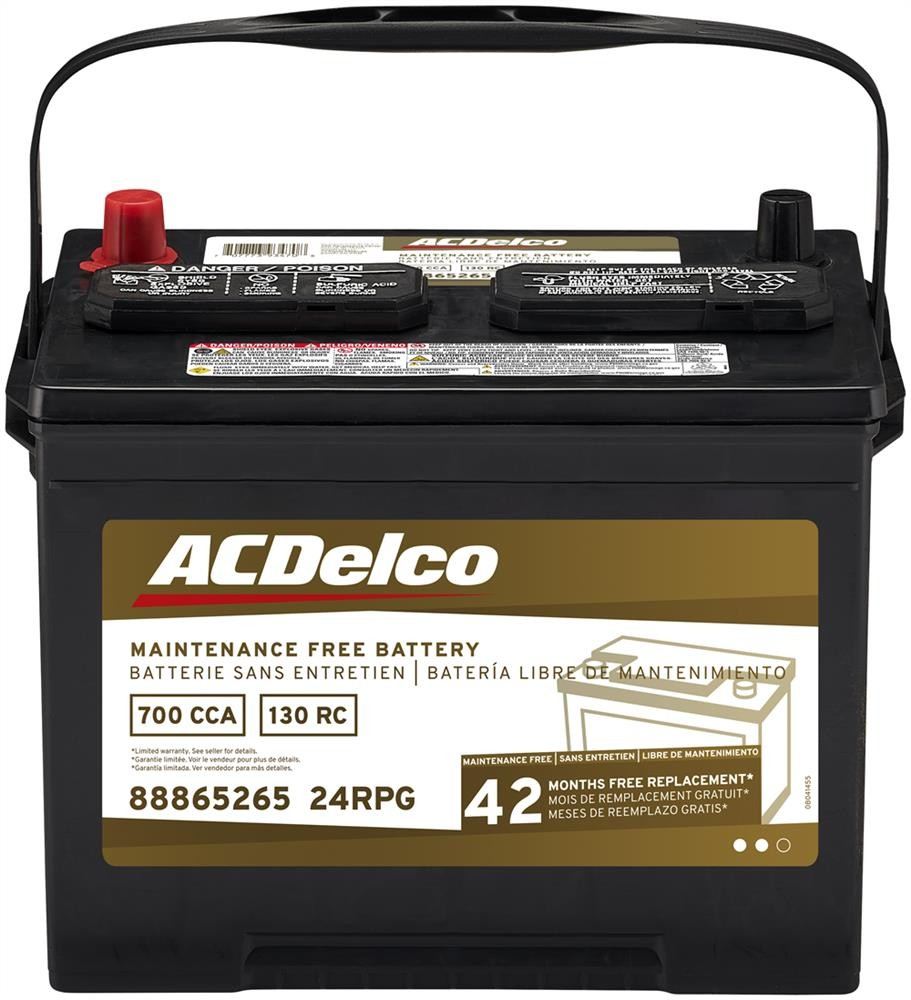
The ACDelco Gold Batteries are a high quality alternative to Original Equipment (OE) parts. These batteries feature an impact- and break-resistant plastic case for durability, including robust separator envelopes for extended auto battery. With a terminal design that resists acid leaks, seepage corrosion and black post, the ACDelco Gold Battery delivers maintenance-free performance and peace of mind. Integral gas separators and flame arrestor vents help prevent possible damage from outside sparks. Premium technology in the metal alloys and a higher amount of Lead, create an impressive performance, even in the coldest temperatures, and allow for more power use in a 'key off' environment. The ACDelco Gold Battery is an ideal replacement auto battery for car and truck applications. ACDelco Gold parts are manufactured to meet your expectations for fit, form, and function, making them a smart choice for General Motors vehicles, as well as most makes and models, including special applications. These high-quality parts are backed by General Motors. Some ACDelco Gold parts may have formerly appeared as ACDelco Professional. ⚠<b> PROPOSITION 65 WARNING:</b> Battery posts, terminals and related accessories contain lead and lead compounds, chemicals known to the state of California to cause cancer, birth defects and other reproductive harm. Batteries also contain other chemicals known to the state of California to cause cancer. Wash hands after handling. | Gold BCI Group 24R Battery
| Height | 8.7 in |
|---|---|
| Weight | 42.7 lb |
| Flooded | Yes |
| Terminal Type | SAE - Type A |
| FAQ - Answer 1 | The Cold Cranking Amps (CCA) test is the number of amps required to crank an engine for 30 seconds at 0 degrees Fahrenheit. Due to lower viscosity engine oils, gear reduction starters and smaller engines having the right amount of CCA is required but not too much. More CCA will not start your car faster. The Reserve Capacity test is the number of minutes that a battery will last with the headlights left on or at a 25 amp draw. Due to the increased electronics in a vehicle, having as much Reserve Capacity as possible is now more important than having the excessive CCA. |
| FAQ - Answer 2 | Most battery manufacturers put the 'CCA' rating right on the label of the battery. Be careful when shopping for batteries as some manufacturers put on the label a reference to 'CA'. This is a reference to 'Cranking Amps' this test is done at 32 degrees Fahrenheit and not at 0 degrees Fahrenheit like the Cold Cranking Amp (CCA) test. |
| FAQ - Answer 3 | This should be on the label right under the CCA rating of the battery. |
| FAQ - Answer 4 | It is important to have the right battery for your vehicle. Refer to OEM specifications in your Owner's manual or an OEM driven supplier such as ACDelco. |
| FAQ - Answer 5 | All batteries need to be maintained. Parasitic drains in a vehicle can deplete a battery in 2-4 weeks. To be safe, vehicles should be started once a week or once every other week and idled for 5 minutes to ensure that the battery retains a reasonable state of charge. |
| FAQ - Answer 6 | Batteries that are Accessible Maintenance Free or Sealed Maintenance Free have a Calcium Additive to the plate material inside the battery that helps to prevent the gassing off of electrolyte. These types of batteries should never need to have water added. Vent caps on these batteries should not be removed at any time as this breaks the seal and could allow seepage or water loss. Low electrolyte in these batteries is an indication of overcharging. Filler Cap batteries have an additive in them that requires the checking and refilling of the battery with distilled water. |
| FAQ - Answer 7 | In the case of GM vehicles, AGM batteries are required for Start-Stop vehicles. Use of a flooded battery will result in the life only being about 4-6 months. Most other vehicle manufacturers are using AGM for these vehicles as well. |
| FAQ - Question 1 | What is more important Cold Crank Amps or Reserve Capacity? |
| FAQ - Question 2 | How can I tell how many Cold Cranking Amps my battery has? |
| FAQ - Question 3 | How can I tell how much reserve capacity my battery has? |
| FAQ - Question 4 | Does this battery perform well in cold weather? |
| FAQ - Question 5 | How long does this battery last without losing its charge? |
| FAQ - Question 6 | What is the difference between a (Accessible) Maintenance-Free Battery and a Filler Cap Battery? |
| FAQ - Question 7 | If my car has a 'start-stop' feature, does this affect what type of battery my car has? |
| Cranking Amperage | 875 A |
| Battery Technology | Flooded |
| Dry With Acid Pack | No |
| Programming Required | No |
| Amps for Load Testing | 350A |
| Negative Terminal Location | Top Left Front |
| Amp Hour Capacity at 20 Hours | 70 Ah |
| Features & Benefits - Bullet 1 | High density negative paste, improves performance and increases auto battery life |
| Features & Benefits - Bullet 2 | Enhanced life alloy/Silver Calcium stamped alloy increases cycle life and improves performance |
| Features & Benefits - Bullet 3 | Calcium Lead positive grid, maximizes conductivity and allows for low resistance |
| Features & Benefits - Bullet 4 | Robust Envelope Separator with puncture-resistant back, allows for increased acid circulation and prevents shorts. Improved acid circulation, helps the battery to remain cool, and extend battery life. |
| Features & Benefits - Bullet 5 | Vent cap design that resists acid leakage |
| Features & Benefits - Bullet 6 | Precision manufactured ribbed case that is 100% pressure tested, helps avoid future leaks and adds strength and rigidity |
| Features & Benefits - Bullet 7 | 100% Electrical short tested to minimize early failures |
| Reserve Capacity Minutes at 25 Amp Load | 130 min |
| Good Maintenance Practices - Section 1 - Bullet 1 | Check the auto battery as part of regular vehicle maintenance. |
| Good Maintenance Practices - Section 1 - Bullet 2 | Keep auto battery terminals clean and free of corrosion. To remove corrosion from terminals use a terminal brush. |
| Good Maintenance Practices - Section 1 - Bullet 3 | Check the alternator and make sure that it is not charging too high or low - if the alternator is not charging properly it will cause the battery to not charge correctly and cause deterioration. |
| Signs of Wear & Troubleshooting - Section 1 - Header | Signs that a battery may need to be replaced are: |
| Signs of Wear & Troubleshooting - Section 1 - Bullet 1 | Engine will not crank |
| Signs of Wear & Troubleshooting - Section 1 - Bullet 2 | Battery runs down easily |
| Signs of Wear & Troubleshooting - Section 1 - Bullet 3 | Battery will not recharge |
| Signs of Wear & Troubleshooting - Section 1 - Bullet 4 | Corroded terminals |
| Signs of Wear & Troubleshooting - Section 1 - Bullet 5 | Cracked/Broken cover or container |
| Signs of Wear & Troubleshooting - Section 1 - Bullet 6 | Frequent slow speed or short distance driving |
| Weight: | 39.2 |
| Transfers : | 14 |
| Alt Inventory: | YES |
| Quantity Required: | 1 |